




Top 10 Benefits of Choosing GBS Malta For International Students
So, here’s a destination that’s been coming up a lot in my consultations lately. Malta. And specifically, Global Banking School Malta. Students are starting to look beyond the traditional...

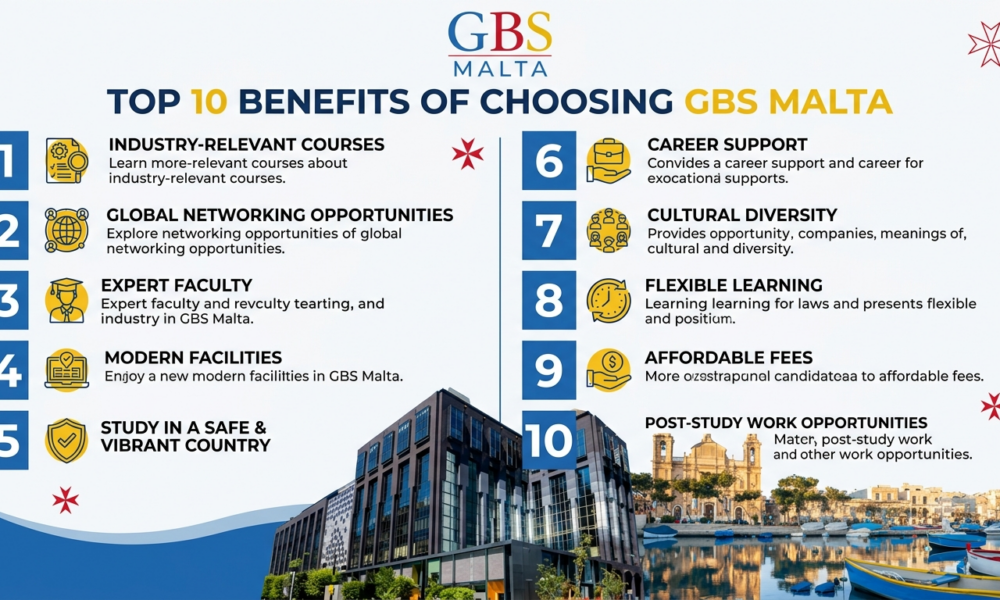
So, here’s a destination that’s been coming up a lot in my consultations lately. Malta. And specifically, Global Banking School Malta. Students are starting to look beyond the traditional UK, US, and Canada options, and honestly? It makes a lot of sense.
Table Of Content
- Benefits of choosing GBS Malta
- 1. The Location Malta Is a Hidden Gem
- 2. Globally Recognised UK Qualifications
- 3. Strong Employability Focus
- 4. Affordable Tuition and Living Costs
- 5. Diverse and Inclusive Learning Environment
- 6. Malta’s Growing International Student Community
- 7. Entry Requirements Are Accessible
- 8. Seamless Progression to UK Universities
- 9. Post-Graduation Work Opportunities
- 10. A Safe and Welcoming Environment
- Final Thoughts
Malta is this beautiful Mediterranean island that’s a member of the European Union, speaks English as one of its official languages, and has a rapidly growing education sector. Global Banking School Malta is part of a larger institution that’s been operating since 2000. They’ve got this reputation for vocational, career-focused education that actually leads to jobs.
Let me walk you through ten benefits that I think make GBS Malta genuinely worth considering.
Benefits of choosing GBS Malta
1. The Location Malta Is a Hidden Gem
Let me start with the obvious one. Malta is stunning. It’s this tiny island nation in the Mediterranean with 300 days of sunshine a year. The food is incredible, the beaches are beautiful, and the cost of living is significantly lower than in the UK.
But here’s what matters for students: Malta is a member of the EU. That means European access, European standards, and European opportunities. The country is also English-speaking, with English being one of the official languages alongside Maltese. You’re not learning in a foreign language environment—you’re learning in English, in a country that feels like a holiday destination. Students consistently tell me that the lifestyle in Malta makes studying genuinely enjoyable. You’re not just surviving—you’re actually living.
2. Globally Recognised UK Qualifications
Here’s the thing about GBS Malta. The qualifications are awarded by UK universities. Global Banking School Malta has partnerships with several UK institutions, including the University for the Creative Arts and the University of East London. This means your degree carries UK university branding while you study in Malta.
That’s a genuinely smart combination. You get the international recognition of a UK degree, but with a more affordable cost of living and a more relaxed environment. The Higher National Diploma programmes are a good example. These are equivalent to the first two years of a UK bachelor’s degree, giving you the option to top up to a full UK degree with just one additional year of study.
3. Strong Employability Focus
What I really like about GBS is that, well they seem to stay focused on employability, not just, I dont know , “education for the sake of it”. Their motto is “Your Success Is Our Success” and honestly they, kind of, live up to it. The courses are made around industry needs, so you’re not only absorbing theory, you’re picking up the sort of practical abilities that employers actually look for.
They offer Higher National Diploma and degree programmes across areas like Business, Accounting, Hospitality, and Computing. Those are fields where Malta has real work openings, not just vague “future potential”. The hospitality scene is booming in Malta. The financial services sector is steadily growing, and the tech ecosystem is expanding too. So it feels less like you’re simply collecting a qualification and more like you’re stepping into the job market.
And the university’s mission is to deliver education that’s accessible and career-driven. That’s not just marketing talk, it’s genuinely what they do.
4. Affordable Tuition and Living Costs
Let’s talk money for a sec, because this actually matters. GBS Malta offers fees that are noticeably lower, compared to the UK, like a lot lower. For international students, tuition usually falls somewhere in the €5,500 to €7,500 per year range, which is honestly a fraction of what many people end up paying across the water.
And then living costs. Those are way calmer too. Rent, meals, transportation—pretty much everything ends up being cheaper than London, Manchester, or Birmingham. Most students end up spending around €800-€1,200 each month for day to day stuff, though it really depends on the lifestyle you go for and the accommodation you choose.
Also, there are scholarships plus early payment discounts, so the whole financial burden becomes, genuinely manageable. I’ve even had students tell me they can finally focus on their studies instead of constantly stressing about cash, all the time.
5. Diverse and Inclusive Learning Environment
GBS Malta gets students from all over the world. You end up learning with people from different countries, different cultures, and various backgrounds , it kinda makes the whole thing feel alive. It’s honestly a very enriching experience, even if you don’t expect it.
The institution is pretty committed to inclusion. Course materials, lectures, and assessments are shaped so they can work well for a varied group of students. International students are helped across the entire route—from the application to graduation. Visa guidance is there too. And there’s a real push to make sure international students feel welcome, and supported , not just “handled”.
Students often tell me that the international setting helps them form global connections that stay useful well after they graduate.
6. Malta’s Growing International Student Community
Malta is, sort of, becoming more and more popular with international students. In 2024 Malta welcomed over 5,700 international students from more than 50 countries. So, it’s a fast growing community and that usually means there are support, infrastructure, and services made specifically for people studying from abroad.
You’re not the first group of international students trying to work things out as you go. There’s already an established community, plus support services , and those helpful networks. Indian students in particular are showing up more and more in Malta. You can often find familiar food, cultural events, and a community vibe that pretty much understands your background without much extra explanation .
7. Entry Requirements Are Accessible
Here’s something that matters: GBS Malta has reasonable entry requirements. For undergraduate programmes, you typically need a high school diploma or equivalent. English proficiency is required, with IELTS 5.5 being common.
This makes GBS accessible to a wider range of students. You don’t need top grades to get in. You don’t need to jump through endless hoops. If you have a solid academic background and meet the English requirements, you’re in.
Postgraduate programmes, where available, typically require a bachelor’s degree and relevant work experience. But again, the requirements are reasonable.
8. Seamless Progression to UK Universities
This is a genuinely clever option. The Higher National Diploma programmes at GBS Malta are equivalent to the first two years of a UK bachelor’s degree. After completing your HND in Malta, you can top up to a full UK degree with just one additional year of study in the UK.
This is a great pathway. You get two years of more affordable education in Malta, followed by one year in the UK. You end up with a UK degree, but you’ve saved significantly on overall costs. The progression is smooth, with established partnerships and articulation agreements in place.
9. Post-Graduation Work Opportunities
Here’s where things get interesting. Malta offers post-graduation work opportunities. Graduates can apply for a work permit to stay and work in Malta after their studies. This is a real advantage. The Maltese economy is growing, and there are genuine employment opportunities in sectors like finance, technology, hospitality, and gaming.
The country is home to numerous international companies, including major financial institutions, tech firms, and gaming operators. These companies regularly hire international graduates. You’re not just getting a degree—you’re getting access to a real job market.
10. A Safe and Welcoming Environment
This is something I don’t talk about enough, but it matters. Malta is consistently ranked as one of the safest countries in the world. The crime rate is low. The people are friendly. The pace of life is relaxed.
For Indian students, this is a genuine advantage. You’re not dealing with the stress of high-crime areas or the anxiety that comes with studying in some bigger cities. You can walk around safely. You can focus on your studies without constantly worrying about your safety.
Maltese people are also genuinely welcoming to international students. There’s a long history of tourism and international business, so locals are used to interacting with people from different countries.
Final Thoughts
Look, GBS Malta isn’t a traditional choice. It’s not Oxford or Cambridge. But here’s the thing it doesn’t need to be. What it offers is something different: affordable, career-focused education in a beautiful location with genuine employment opportunities.
If you’re looking for a UK-style education but want to avoid the high costs of studying in the UK, GBS Malta is genuinely worth considering. The partnerships with UK universities, the affordable fees, the strong employability focus, and the growing international student community all point to one thing: this is a smart, sensible option.
If you’re considering Global Banking School Malta as your study destination, I’d strongly recommend reaching out to study in Malta Consultants for Indian Students who can guide you through the application process, visa requirements, and scholarship opportunities. The right advice at the right time can make all the difference.
Whatever you decide, make sure you’re choosing a programme that aligns with where you want to go, not just what sounds good on paper. That’s the advice I give every student, and it’s never steered anyone wrong.







No Comment! Be the first one.