


Agile vs Scrum Certification: Skills & Career Growth
Agile methodologies have transformed how organizations deliver software, manage projects, and respond to changing business requirements. Among the most recognized approaches are Agile and Scrum,...

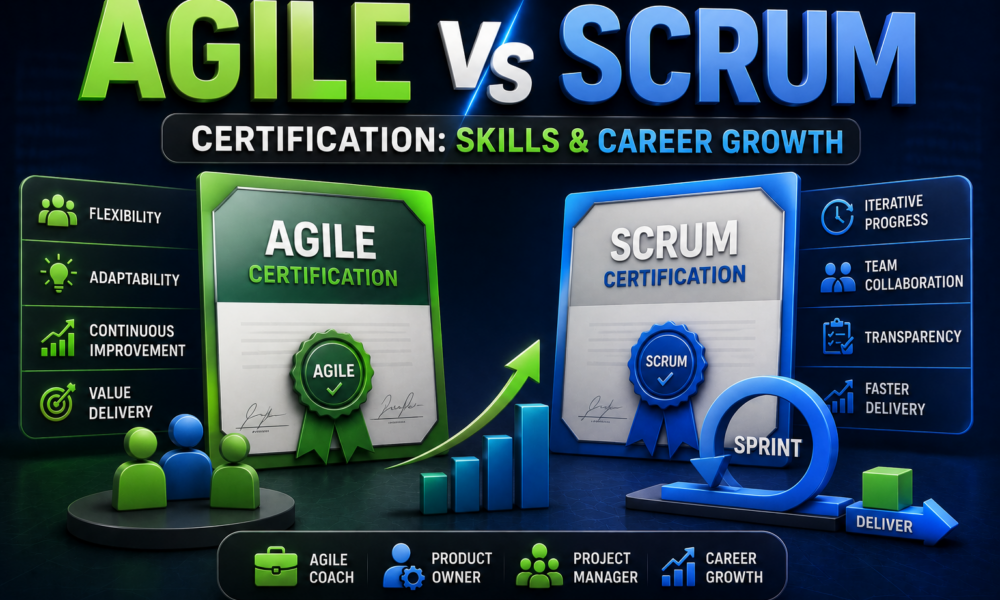
Agile methodologies have transformed how organizations deliver software, manage projects, and respond to changing business requirements. Among the most recognized approaches are Agile and Scrum, which are often mentioned together but serve different purposes. While Agile is a broader project management philosophy, Scrum is one of the most widely adopted Agile frameworks.
Table Of Content
- Understanding Agile Certification
- Understanding Scrum Certification
- Agile vs Scrum: Key Differences
- Skills You’ll Learn
- Training Requirements
- Career Opportunities
- Which Certification Is Easier?
- Which Certification Offers Better Career Growth?
- Choosing the Right Certification
- Future Outlook
- Conclusion
- FAQs
- Is Scrum the same as Agile?
- Which certification is better for beginners?
- Can I earn both Agile and Scrum certifications?
- Which certification offers better career opportunities?
- Are Agile and Scrum certifications still valuable in 2026?
For IT professionals, project managers, software developers, business analysts, Scrum Masters, and product owners, choosing between an Agile certification and a Scrum certification can be challenging. Both certifications enhance career opportunities, but they validate different skills and prepare professionals for different responsibilities.
This guide compares Agile and Scrum certifications, their training requirements, skills, career opportunities, and long-term value to help you choose the certification that best aligns with your career goals in 2026.
Understanding Agile Certification
Agile is a project management philosophy built around flexibility, collaboration, continuous improvement, and customer feedback. Instead of following a rigid project plan, Agile teams deliver work incrementally while adapting to changing business needs.
Agile certifications focus on teaching Agile values, principles, planning techniques, collaboration methods, iterative development, stakeholder communication, and continuous delivery practices.
Rather than concentrating on one specific framework, Agile certifications introduce professionals to multiple Agile approaches, including Scrum, Kanban, Lean, and Extreme Programming (XP). This broad understanding helps professionals work effectively across different Agile environments.
Understanding Scrum Certification
Scrum is a structured framework that implements Agile principles through defined roles, ceremonies, and artifacts.
Scrum certifications focus specifically on managing Scrum teams, facilitating Sprint Planning, conducting Daily Scrums, Sprint Reviews, Sprint Retrospectives, backlog refinement, and delivering incremental product improvements.
Candidates learn how Scrum teams collaborate, how Product Owners prioritize work, and how Scrum Masters remove obstacles that affect team productivity.
Because Scrum has clearly defined processes and responsibilities, Scrum certifications are often the first choice for professionals working in Agile software development teams.
This concept is explained in greater depth in a YouTube video shared by Cert Empire.
Agile vs Scrum: Key Differences
Although the two concepts are closely related, they are not the same.
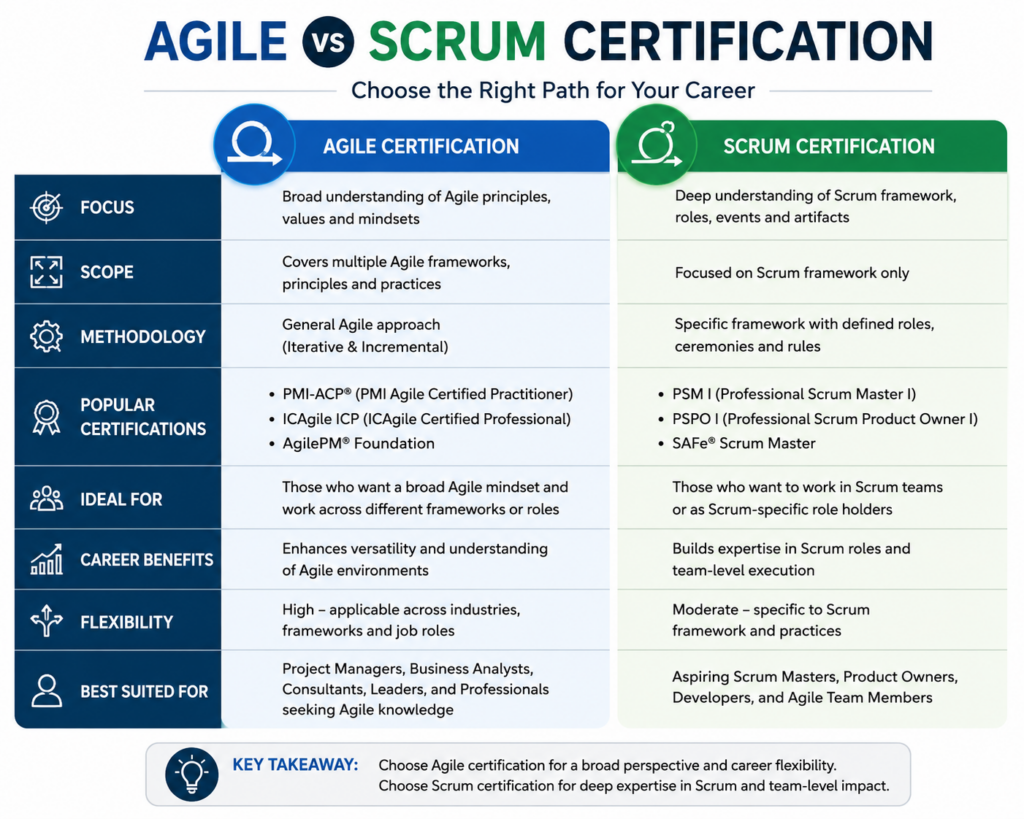
| Feature | Agile Certification | Scrum Certification |
| Focus | Agile principles and methodologies | Scrum framework |
| Scope | Broad | Specific |
| Learning Style | Multiple Agile approaches | Scrum practices |
| Team Structure | Flexible | Defined Scrum roles |
| Best For | General Agile professionals | Scrum teams |
Agile provides the philosophy, while Scrum provides one practical framework for implementing Agile principles.
Skills You’ll Learn
Agile certifications develop broad project management and collaboration skills.
Typical topics include:
- Agile principles
- Iterative planning
- Customer collaboration
- Continuous improvement
- Agile estimation
- Risk management
- Team communication
- Adaptive planning
Scrum certifications focus on practical team execution.
Candidates learn:
- Scrum roles
- Sprint Planning
- Product Backlog management
- Sprint Reviews
- Sprint Retrospectives
- Daily Scrum meetings
- Scrum events
- Incremental delivery
Both certifications improve collaboration, but Scrum places greater emphasis on structured team execution.
Training Requirements
Most Agile certifications begin with introductory concepts before progressing to more advanced methodologies. Some certification providers recommend classroom training or online learning, while others allow candidates to prepare independently.
Scrum certification programs generally provide focused training on Scrum roles, artifacts, and ceremonies. Depending on the certification provider, official training may be recommended or required before taking the examination.
Regardless of the certification path you choose, combining structured learning with practical project experience usually produces the best results.
Career Opportunities
Both certifications support careers in modern software development and project management.
Professionals with Agile certifications commonly pursue roles such as:
- Agile Project Manager
- Agile Coach
- Delivery Manager
- Business Analyst
- Product Manager
- Transformation Consultant
Scrum certifications commonly support positions including:
- Scrum Master
- Product Owner
- Agile Team Lead
- Project Coordinator
- Software Development Manager
- Delivery Lead
Many organizations value professionals who understand both Agile principles and Scrum practices.
Which Certification Is Easier?
For many beginners, Scrum certification feels more structured because it focuses on one specific framework with clearly defined terminology, roles, and processes.
Agile certifications often cover a broader range of methodologies and concepts, requiring candidates to understand multiple approaches to project delivery.
Neither certification is objectively harder. The level of difficulty depends on your experience, learning style, and the certification provider you choose.
Which Certification Offers Better Career Growth?
Career growth depends largely on your professional goals.
If you plan to work directly within Scrum teams, become a Scrum Master, or manage Agile software delivery, earning a Scrum Certification is an excellent choice. If your responsibilities involve organizational transformation, Agile coaching, project leadership, or working across multiple Agile frameworks, an Agile Certification may provide broader long-term value.
Many experienced professionals eventually earn both Scrum Certification and Agile Certification because these credentials complement one another and expand career opportunities across different industries.
Choosing the Right Certification
Consider your current role before making a decision.
Choose an Agile certification if you:
- Want a broad understanding of Agile methodologies.
- Work across multiple Agile frameworks.
- Plan to become an Agile Coach or Project Manager.
- Support enterprise Agile transformation.
Choose a Scrum certification if you:
- Work in Scrum development teams.
- Want to become a Scrum Master.
- Manage Product Backlogs or Sprint activities.
- Focus on software delivery and team facilitation.
Selecting the certification that aligns with your daily responsibilities often leads to better learning outcomes.
Future Outlook
Organizations continue adopting Agile practices to improve software delivery, increase collaboration, and respond more effectively to changing customer needs. Scrum remains the most widely implemented Agile framework, while broader Agile knowledge is increasingly valuable for professionals leading digital transformation initiatives.
Professionals who understand both Agile principles and Scrum implementation are well positioned for long-term career growth across software development, IT operations, cloud projects, and business transformation programs.
Many professionals preparing for Agile and Scrum certifications use learning resources from Cert Empire to strengthen their understanding of certification objectives, Agile concepts, and practical exam preparation strategies.
Conclusion
Agile and Scrum certifications both offer valuable opportunities for IT professionals, but they serve different purposes. Agile certifications provide a broad understanding of modern project management methodologies, while Scrum certifications focus on the practical implementation of one of the world’s most popular Agile frameworks.
The best certification depends on your current role, career goals, and the type of projects you manage. Whether you begin with Agile or Scrum, developing practical experience alongside certification preparation will help you build the skills needed for long-term success in today’s fast-changing IT industry.
FAQs
Is Scrum the same as Agile?
No. Agile is a project management philosophy, while Scrum is one framework used to implement Agile principles.
Which certification is better for beginners?
Scrum certification is often recommended for beginners because it follows a structured framework that is widely adopted by software development teams.
Can I earn both Agile and Scrum certifications?
Yes. Many professionals earn both certifications to gain a broader understanding of Agile methodologies and practical Scrum implementation.
Which certification offers better career opportunities?
Both certifications are valuable. Scrum supports team-focused delivery roles, while Agile certifications prepare professionals for broader project management and transformation responsibilities.
Are Agile and Scrum certifications still valuable in 2026?
Yes. As organizations continue adopting Agile delivery models, both certifications remain highly relevant across software development, cloud computing, DevOps, and digital transformation projects.





No Comment! Be the first one.