



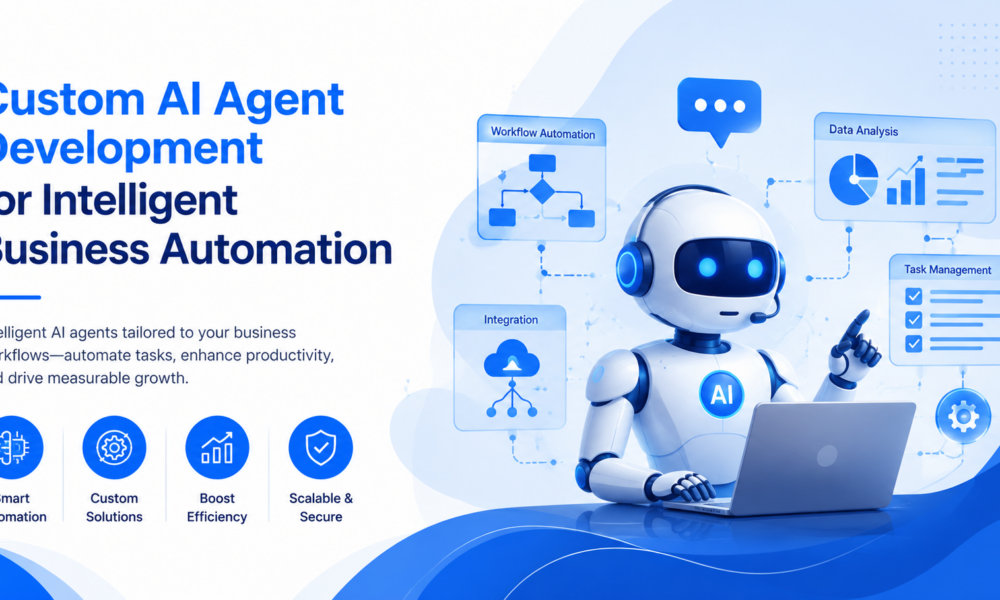
Custom AI Agent Development for Intelligent Business Automation
A restaurant owner doesn’t run their kitchen the same way a law firm runs its intake process, and yet most off-the-shelf automation tools expect both to fit into the same rigid template. That...

A restaurant owner doesn’t run their kitchen the same way a law firm runs its intake process, and yet most off-the-shelf automation tools expect both to fit into the same rigid template. That mismatch is exactly why “automation” got a bad reputation for years — businesses bought generic software, forced their workflows to bend around it, and ended up with a tool nobody on the team actually wanted to use. Custom AI agents flip that relationship entirely. Instead of your business adapting to the software, the software gets built around how your business actually operates — who makes which decisions, what data matters at each step, and where a human absolutely needs to stay in the loop. That distinction between generic and custom isn’t a minor technical detail; it’s the difference between automation that quietly saves you hours every week and automation that becomes one more system your team has to work around.
Table Of Content
- The Problem With Treating Every Business Like It’s the Same
- How a Capable AI Agent Development Company Approaches Your Business Differently
- What Falls Under AI Agent Development Services, Practically Speaking
- Matching the Right AI Agent Development Solutions to the Right Problem
- The Case for Choosing to Hire AI Agent Developers Over a Patchwork of Tools
- Phone Calls Still Matter: The Case for AI Voice Agent Development
- Sales Teams Move Faster With AI Sales Agent Development
- Scaling Beyond a Single Team: Enterprise AI Agent Development
- Building This the Right Way From the Start
- Final Thoughts
The Problem With Treating Every Business Like It’s the Same
Walk through ten different businesses and you’ll find ten different definitions of what “a good customer interaction” looks like. A dental clinic needs an agent that can triage urgency over the phone and know when a situation genuinely can’t wait until Monday. An e-commerce brand needs something that can handle order status questions instantly but knows to escalate the moment a customer mentions a damaged product and a refund. A B2B software company needs an agent that understands the difference between a curious browser and a buyer ready to talk pricing. None of these are solved by the same generic chatbot template, which is exactly why pre-built tools tend to plateau quickly — they handle the obvious 80% of cases fine, then fall apart on the nuanced 20% that actually determines whether a customer stays or leaves frustrated.
- Generic tools force your workflows to conform to their limitations
- Edge cases — the ones that matter most — often go unhandled by templated solutions
- Custom agents reflect your actual decision logic, not a generic best guess
- Industry-specific nuance (urgency, tone, compliance) gets lost in one-size-fits-all builds
- Off-the-shelf tools rarely integrate cleanly with the exact systems you already use
How a Capable AI Agent Development Company Approaches Your Business Differently
The first meeting with a serious AI agent development company rarely starts with a sales pitch about technology — it starts with questions about your business. What does a typical customer interaction look like today? Where do things go wrong? What decisions are your team making manually that follow a recognizable pattern? This discovery phase matters more than people expect, because an agent built without genuinely understanding your operations tends to automate the wrong things, or worse, automates the right thing badly. A team that’s done this well across other industries brings pattern recognition you can’t easily replicate internally — they’ve seen where agents tend to fail, what guardrails actually prevent costly mistakes, and how to design for the messy reality of real customers rather than the clean demo version of your business.
- Deep discovery into existing workflows before any technical design begins
- Mapping decision points to determine what’s safe to automate versus not
- Designing guardrails based on patterns seen across multiple past projects
- Building for real-world edge cases, not just the clean, ideal-case scenario
- Iterative testing with your actual team before any customer-facing rollout
What Falls Under AI Agent Development Services, Practically Speaking
Business owners often picture “building an agent” as a single deliverable — flip a switch, and suddenly there’s a smart assistant running your operations. In reality, solid AI agent development services span a much wider arc: understanding your data sources, designing how the agent reasons through a task, connecting it securely to your existing software stack, and building in monitoring so you can actually see what the agent did and why. Just as important is what happens after launch — agents need tuning as your business changes, as new edge cases surface, and as your team gets more comfortable trusting (or correctly distrusting) certain types of decisions to automation. Treating this as an ongoing relationship rather than a one-time build is usually what separates a project that keeps improving from one that quietly degrades over time.
- Data and systems audit to determine what the agent can safely access
- Reasoning and decision-flow design tailored to your specific use case
- Secure integration with CRMs, scheduling tools, payment systems, and databases
- Built-in monitoring and logging so every agent action remains auditable
- Ongoing tuning and retraining as your business and customer patterns evolve
Matching the Right AI Agent Development Solutions to the Right Problem
Not every part of your business needs the same kind of agent, and pretending otherwise usually leads to wasted effort on automation nobody asked for. The smartest approach is starting with whichever bottleneck actually costs you the most time or money right now, then expanding from there once that first deployment proves itself. Some businesses discover their real bottleneck is in operations — data entry, reconciliation, scheduling — long before customer-facing automation even makes sense. Others find their support team is drowning in repetitive tickets while their sales pipeline runs fine. The right AI agent development solutions come from an honest internal assessment of where the pain actually is, not from chasing whatever automation trend is getting the most attention online.
- Start by identifying the single highest-friction, highest-volume task in your business
- Resist the urge to automate everything simultaneously in a first rollout
- Separate customer-facing agents from internal operations agents in your planning
- Prioritize use cases with clear, measurable outcomes you can track post-launch
- Let early results inform what gets automated next, rather than guessing upfront
The Case for Choosing to Hire AI Agent Developers Over a Patchwork of Tools
Plenty of businesses try to cobble together automation using a mix of no-code platforms, Zapier-style connectors, and whatever AI features their existing software vendors bolted on last quarter. This patchwork approach can work for very simple needs, but it tends to break down fast once you need agents that reason across multiple steps, handle exceptions gracefully, or integrate deeply with sensitive systems. At that point, most business owners realize it’s more efficient to Hire AI Agent Developers who can design something cohesive from the ground up, rather than continuing to duct-tape together tools that were never built to talk to each other in the first place. The upfront cost of proper development is almost always lower than the long-term cost of maintaining a fragile, patchworked system that breaks every time one connected tool updates its API.
- Avoid the fragility of stitching together multiple disconnected no-code tools
- Get a cohesive system designed around your workflows, not generic connectors
- Reduce long-term maintenance headaches from tools that weren’t built to integrate
- Gain proper security review instead of relying on third-party platform defaults
- Build something that scales cleanly instead of hitting a ceiling within months
Phone Calls Still Matter: The Case for AI Voice Agent Development
For a huge number of businesses — clinics, salons, contractors, real estate offices — the phone is still where a meaningful chunk of customer relationships start, and missed calls quietly cost more revenue than most owners realize until they actually track it. AI Voice Agent Development addresses this directly by handling inbound calls with a voice that sounds natural enough that callers don’t immediately hang up in frustration, booking appointments, answering common questions, and routing anything complex to a human without making the caller repeat themselves twice. The technology has reached a point where the conversation feels considerably more human than the robotic IVR systems business owners associate with “phone automation” from a decade ago, which is exactly why adoption here has picked up so quickly across service-based industries.
- Captures after-hours calls that would otherwise go to voicemail and get lost
- Handles appointment booking and rescheduling without manual staff involvement
- Reduces hold times during peak call volume by resolving simple requests instantly
- Passes context to human staff seamlessly when a call needs to be escalated
- Provides call transcripts and summaries automatically for better record-keeping
Sales Teams Move Faster With AI Sales Agent Development
Ask any sales leader where their team’s time actually goes, and a surprising amount of it is spent on tasks that have nothing to do with closing — chasing unresponsive leads, manually qualifying inbound interest, sending the same intro email with minor tweaks each time. AI Sales Agent Development targets exactly this gap, building agents that engage new leads immediately, ask the qualifying questions a rep would normally ask first, and only push genuinely promising prospects onto a human’s calendar. This isn’t about removing the human element from sales — relationship-building and negotiation still need a person — it’s about making sure your best closers spend their time talking to people who are actually ready to buy, instead of working through a list where most leads were never going to convert in the first place.
- Engages and responds to new leads within minutes instead of hours or days
- Asks qualifying questions automatically to filter serious prospects from browsers
- Sends personalized follow-up sequences without manual effort from reps
- Books qualified meetings directly onto a closer’s calendar
- Frees experienced sales staff to focus purely on conversations that matter
Scaling Beyond a Single Team: Enterprise AI Agent Development
What works cleanly for one department rarely scales the same way across an entire organization, and this is where things get genuinely more demanding. Enterprise AI Agent Development has to account for multiple teams deploying agents simultaneously, strict access controls so one department’s automation can’t accidentally touch another’s sensitive data, and integration with legacy systems that were never designed with AI in mind. There’s also the matter of governance — larger organizations typically need every agent decision to be traceable, explainable, and reviewable for compliance purposes, which adds a layer of complexity that a small business pilot simply doesn’t have to deal with. This is precisely why enterprises tend to lean on development partners with experience managing this kind of scale, rather than trying to extend a small departmental project organically across the whole company.
- Role-based permissions ensuring agents only access data relevant to their function
- Centralized oversight across multiple departments running separate agent deployments
- Compatibility planning for legacy systems that predate modern AI integration
- Compliance-ready audit trails for every significant agent decision
- Structured rollout plans that account for change management across large teams
Building This the Right Way From the Start
The businesses that get the most value from AI agents tend to share one trait: they didn’t try to automate everything at once. They picked a single, well-understood problem, built something properly around it, measured the results honestly, and only then moved on to the next opportunity. This patience pays off in two ways — it gives your team time to build trust in the system gradually, and it gives you real data to inform what’s worth automating next, instead of guessing based on whatever sounds impressive in a vendor pitch. Custom development takes more thought upfront than grabbing a generic tool off the shelf, but it’s also the difference between automation that actually fits your business and automation you end up quietly abandoning six months later.
- Choose one clearly defined problem before expanding to additional use cases
- Set measurable success criteria before development begins, not after launch
- Keep a human reviewing agent decisions closely during the first weeks live
- Gather direct feedback from staff working alongside the agent day to day
- Treat the first deployment as a foundation, not a finished, untouchable system
Final Thoughts
Custom AI agents aren’t about chasing the latest tech trend — they’re about finally automating the parts of your business that were always repetitive and predictable, without forcing your operations to conform to someone else’s generic template. The businesses seeing real results from this aren’t necessarily the ones with the biggest budgets; they’re the ones who took the time to understand their own bottlenecks clearly and partnered with developers who asked good questions before writing a single line of code. Start with the problem that actually costs you the most right now, build it properly, and let the results guide whatever comes next.




No Comment! Be the first one.